Vernon Bogdanor: Remarkable Career, Age and Constitutional Work
A clear look at Vernon Bogdanor’s age, education, books, academic career, honours and influence on British constitutional thought

Introduction
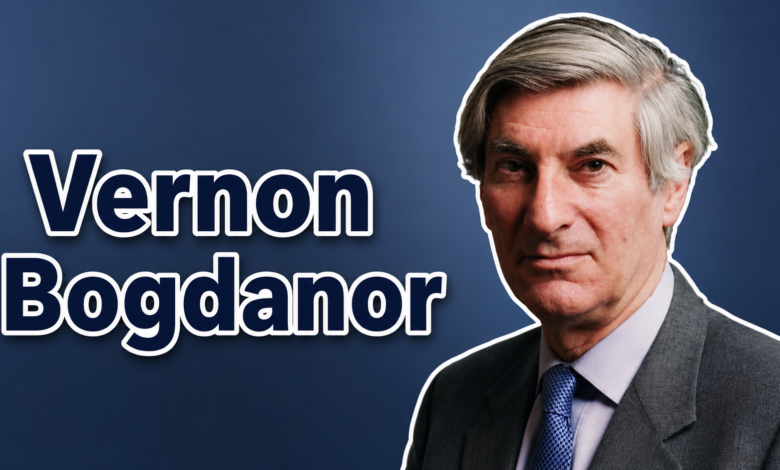
Vernon Bogdanor is a British political scientist, constitutional historian, academic and author. He is widely respected for explaining how the British constitution, Parliament, elections, monarchy and government work.
He spent much of his academic career at the University of Oxford and later became a research professor at King’s College London. His books and public lectures have helped students, politicians and ordinary readers understand complex political questions in clear language.
Who Is Vernon Bogdanor?
His full name is Vernon Bernard Bogdanor. He was born on 16 July 1943 in Staines, Middlesex, England.
He is 82 years old as of 12 July 2026 and will turn 83 on 16 July 2026. He holds British nationality and is professionally known as Professor Sir Vernon Bogdanor CBE, FBA.
He is famous for his knowledge of the British constitution and for writing about electoral reform, devolution, Parliament, monarchy, democracy and Britain’s relationship with Europe.
Quick Bio
| Field | Verified detail |
|---|---|
| Full name | Vernon Bernard Bogdanor |
| Professional name | Vernon Bogdanor |
| Date of birth | 16 July 1943 |
| Age | 82 years old as of 12 July 2026 |
| Birthplace | Staines, Middlesex, England |
| Nationality | British |
| Profession | Political scientist, academic, author and constitutional historian |
| Education | Philosophy, Politics and Economics at Oxford |
| University | The Queen’s College, University of Oxford |
| Current academic role | Research Professor at King’s College London |
| Former role | Professor of Government at the University of Oxford |
| Main field | British politics and constitutional government |
| Honour | Knight Bachelor |
| Other titles | CBE and Fellow of the British Academy |
| Famous for | Explaining the British constitution and supporting political reform |
Early Life and Background
He was born in Staines and grew up in Uxbridge, Middlesex.
Published accounts of his early years say that both of his parents worked as pharmacists. During his school years, an enthusiastic history teacher helped develop his interest in history and public affairs.
He attended Bishopshalt School in Uxbridge. His interest in government, history and political institutions later guided him towards one of Oxford’s best-known social-science courses.
Private family details that are not consistently confirmed by official sources should not be treated as established facts.
Education at the University of Oxford
He studied Philosophy, Politics and Economics, commonly called PPE, at The Queen’s College, University of Oxford.
PPE combines the study of political institutions, economic systems and philosophical ideas. This education provided a strong foundation for his later research into government, elections and constitutional law.
He completed his undergraduate studies in 1964. The Queen’s College later made him an Honorary Fellow in recognition of his academic achievements and public contribution.
Beginning of His Academic Career
His long academic career began at Brasenose College, Oxford, where he became a Fellow in Politics in 1966.
He later served in several senior positions at the college, including Senior Tutor, Vice-Principal and Acting Principal. These roles involved teaching, academic leadership and responsibility for college administration.
He eventually became Professor of Government at the University of Oxford. He remained closely connected with Oxford until 2010.
His work was not limited to lectures and university teaching. He also wrote books, advised public institutions and regularly appeared in newspapers, television programmes and radio discussions.
Career at King’s College London
After leaving his full-time Oxford position, he joined King’s College London.
King’s lists him as a Research Professor at the Centre for British Politics and Government. His research focuses on British government, democracy, political institutions and constitutional history.
His move to King’s allowed him to continue writing, teaching and contributing to national political debates. The university describes him as a leading expert on the history and structure of the British constitution.
Readers interested in another British figure connected with constitutional and human-rights law can also read about Ben Emmerson’s legal career and international work.
Work at Gresham College
He served as Professor of Law at Gresham College from 2004 to 2008.
From 2008 until 2013, he held the position of Visiting Professor of Political History. He is now recognised as Emeritus Gresham Professor of Law.
His public lectures have covered subjects including:
- The British constitution
- General elections
- Prime ministers
- Political parties
- Constitutional monarchy
- Electoral systems
- Britain’s relationship with Europe
- Political change during the twentieth century
These lectures helped make detailed academic knowledge available to people outside universities.
Constitutional and Government Advisory Work
His expertise has also been used outside academic institutions.
He has advised government and parliamentary bodies on constitutional and electoral questions. His international advisory work has involved countries including Albania, the Czech Republic, Hungary, Israel, Kosovo, Mauritius, Romania, Slovakia, Sweden and Trinidad.
This work has included questions about democratic institutions, elections, government accountability and the protection of minorities.
He has also advised committees in the British Parliament and contributed to discussions about devolution, public services and constitutional reform.
Books Written by Vernon Bogdanor
He has written and edited many books about government, elections and constitutional development.
Some of his best-known works include:
- Devolution
- The People and the Party System
- Multi-Party Politics and the Constitution
- What Is Proportional Representation?
- The Monarchy and the Constitution
- Power and the People
- Devolution in the United Kingdom
- The New British Constitution
- The Coalition and the Constitution
- Beyond Brexit: Towards a British Constitution
- Britain and Europe in a Troubled World
- The Strange Survival of Liberal Britain
- Making the Weather: Six Politicians Who Changed Modern Britain
These books examine how political power is organised, how citizens are represented and how constitutional rules change over time.
People looking for more verified career and background profiles can explore TopicMint’s latest public-figure articles.
Making the Weather
One of his more recent books is Making the Weather: Six Politicians Who Changed Modern Britain.
The book focuses on six politicians who had a major influence on British political debate despite never becoming prime minister:
- Aneurin Bevan
- Roy Jenkins
- Tony Benn
- Enoch Powell
- Keith Joseph
- Nigel Farage
The central idea is that a politician does not need to hold the country’s highest office to change public opinion or influence government policy.
Through these six figures, the book examines the development of modern arguments about welfare, Europe, immigration, markets and national identity.
Political and Constitutional Views
His work supports clearer democratic accountability and a better public understanding of government.
He has written positively about constitutional monarchy while also supporting important political reforms. He has frequently examined the weaknesses of Britain’s first-past-the-post electoral system and the possible benefits of proportional representation.
His research has focused on several important questions:
- How much power should a government have?
- How should Parliament hold ministers accountable?
- Should the United Kingdom adopt a written constitution?
- How should elections represent different political opinions?
- What powers should be transferred to Scotland, Wales and Northern Ireland?
- How should minority rights be protected?
- What constitutional role should the monarchy play?
He does not simply describe political institutions. Much of his work considers how they could become fairer, clearer and more democratic.
Connection With David Cameron
One of his best-known former students is David Cameron, who later served as Prime Minister of the United Kingdom from 2010 until 2016.
He taught Cameron while the future political leader was studying PPE at Brasenose College.
He later commented publicly on Cameron’s policies and constitutional ideas. Although he described Cameron as an able student, he did not automatically support all of his former student’s political proposals.
This relationship became widely discussed because it connected one of Britain’s leading constitutional teachers with a future prime minister.
Media Work and Public Commentary
He has frequently appeared on television and radio and has written for national newspapers and academic journals.
His media work has included explaining:
- General-election results
- Referendums
- Brexit
- Parliamentary power
- Constitutional disputes
- Electoral reform
- The role of prime ministers
- Human-rights protections
He served as an academic expert during the BBC’s coverage of the 2010 general election and the 2016 referendum on membership of the European Union.
He has also worked as a historical and constitutional adviser for dramatic productions.
His consulting work included Darkest Hour, a film about Winston Churchill, and The Audience, a stage production about meetings between Queen Elizabeth II and British prime ministers.
Awards and Honours
His academic and public work has received major recognition.
Fellow of the British Academy
He was elected a Fellow of the British Academy in 1997.
The British Academy is the United Kingdom’s national academy for the humanities and social sciences. His official British Academy profile lists his main subject as politics and his specialist fields as political theory, government and international relations.
Commander of the Order of the British Empire
He was appointed a Commander of the Order of the British Empire, commonly written as CBE, in 1998.
The honour recognised his services to constitutional history.
Sir Isaiah Berlin Prize
In 2008, the Political Studies Association awarded him the Sir Isaiah Berlin Prize for his lifetime contribution to political studies.
French Honour
In 2009, he was appointed a Chevalier of the Légion d’honneur by France.
This recognised his contribution to the study of British and French political history and law.
Knighthood
He was knighted in the 2023 New Year Honours for services to political science.
King’s College London noted that his work had helped explain the unwritten principles of Britain’s constitutional system.
Why He Became Famous
He became famous because he could explain complicated constitutional questions in language that non-specialists could understand.
Unlike politicians, he does not depend on election campaigns or party office. His authority comes mainly from decades of academic study, teaching, publishing and public analysis.
His books became useful to:
- University students
- Journalists
- Lawyers
- Civil servants
- Politicians
- Political researchers
- Readers interested in British government
His reputation also grew because major political events repeatedly raised questions that he had studied for years.
Devolution, referendums, coalition government, Brexit and debates about electoral reform all increased public interest in his work.
Current Role and Status
He continues to be publicly associated with King’s College London as a research professor and remains active as an author and political commentator.
His official King’s College London profile describes him as a research professor specialising in British politics and government.
His recent work has continued to examine modern British politics, constitutional reform, Europe and the influence of major political thinkers.
Interesting Facts
- His full name is Vernon Bernard Bogdanor.
- He began his Oxford fellowship in 1966.
- He taught former prime minister David Cameron.
- He has advised several national governments.
- He has written extensively about proportional representation.
- He has studied both monarchy and democratic reform.
- He worked as an expert during major BBC political broadcasts.
- He advised productions about Winston Churchill and Queen Elizabeth II.
- He received honours from both Britain and France.
- He was knighted for services to political science.
Frequently Asked Questions
How old is Vernon Bogdanor?
He is 82 years old as of 12 July 2026. He was born on 16 July 1943.
What is Vernon Bogdanor’s nationality?
He is British.
Where was he born?
He was born in Staines, Middlesex, England.
What is he famous for?
He is famous for his academic work on the British constitution, political reform, elections, devolution and monarchy.
Where did he study?
He studied Philosophy, Politics and Economics at The Queen’s College, University of Oxford.
Where does he work?
He is publicly listed as a research professor at King’s College London.
Did he teach David Cameron?
Yes. David Cameron was one of his students at Brasenose College, Oxford.
Why was he knighted?
He was knighted in the 2023 New Year Honours for services to political science.
What does CBE mean?
CBE means Commander of the Order of the British Empire.
What does FBA mean?
FBA means Fellow of the British Academy.
What are his best-known books?
His notable books include The Monarchy and the Constitution, The New British Constitution, Beyond Brexit and Making the Weather.
Final Words
Vernon Bogdanor has spent more than five decades studying how Britain is governed.
His teaching, books and public lectures have helped explain elections, Parliament, monarchy, devolution and constitutional reform to generations of readers.
His influence comes from combining detailed historical knowledge with clear explanations of modern political problems. His career has made him one of Britain’s most recognised academic voices on constitutional government.